
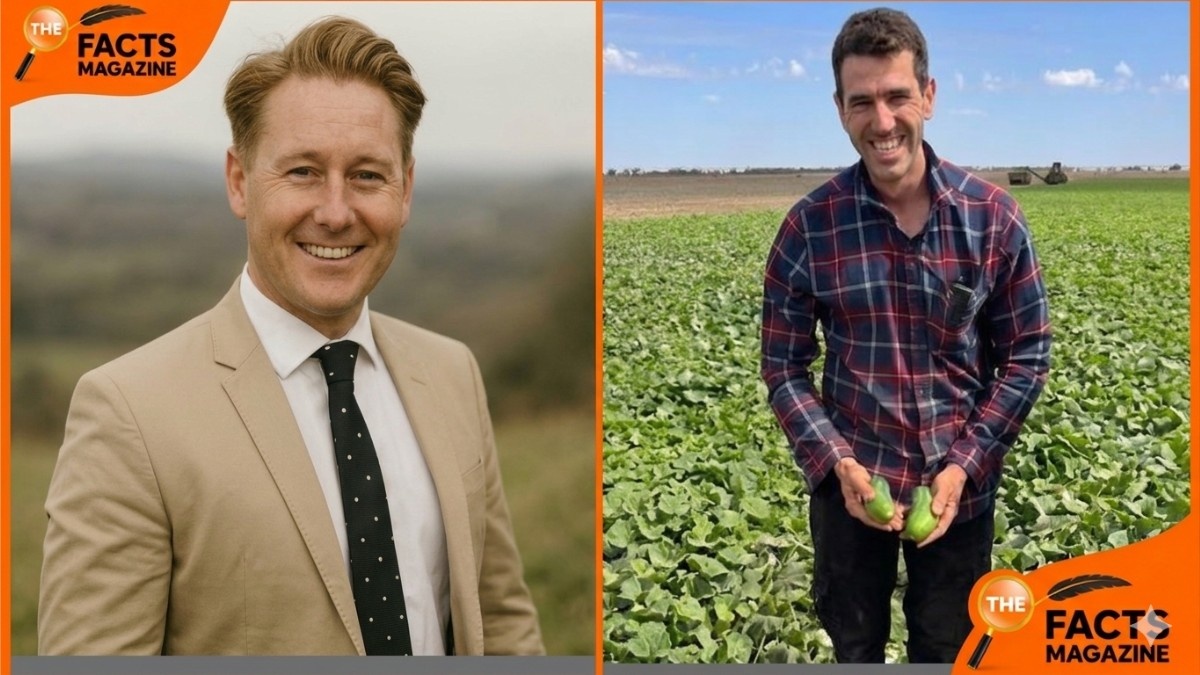
Order a Big Mac anywhere in Australia and odds are you’re crunching on something grown by one quiet family farm sitting out near Griffith, New South Wales. The man at the centre of it all is Tony Parle. No red carpets, no weekly TV slot, no hunger for attention. And yet his pickles land in burger after burger — and that strange little detail is precisely what keeps drawing people to his name.
- Introduction: Why Tony Parle Is Gaining Attention Online
- Who Is Tony Parle?
- Tony Parle’s Early Life and Farming Background
- How Tony Parle Entered the Gherkin Business
- Tony Parle and McDonald’s Australia: How the Partnership Began
- How Tony Parle’s Pickles Are Produced
- Inside the Parle Family Farm Operation
- How Many Pickles Does Tony Parle Produce?
- The Business Side of Tony Parle’s Agribusiness
- Setbacks, Receivership, and Recovery
- Why Tony Parle Is Called the Pickle King
- Tony Parle’s Impact on Australian Agriculture
- Awards, Recognition, and Industry Credibility
- Tony Parle’s Family, Privacy, and Public Image
- Key Lessons from Tony Parle’s Story
- Conclusion: Tony Parle’s Legacy in Farming, Pickles, and Food Supply
- FAQs About Tony Parle
Introduction: Why Tony Parle Is Gaining Attention Online
Here’s the thing — folks have grown genuinely curious about the origins of their food. Tony Parle turned into one of those surprising internet detours because his story settles a question almost nobody thinks to ask: where does the pickle on an Aussie McDonald’s burger actually come from?
And honestly, the answer is more fascinating than you’d guess. One regional family, decades on the same land, keeps more than 1,000 McDonald’s outlets supplied right across the nation. No sprawling corporation. Just graft, precise timing, and a refusal to throw in the towel. That mismatch — tiny farm, enormous footprint — is what hooks readers and won’t let go.
|
Quick Facts |
Details |
|---|---|
|
Full Name |
Tony Parle |
|
Known For |
Supplying pickles to McDonald’s Australia |
|
Nationality |
Australian |
|
Location |
Tabbita, near Griffith, Riverina region, NSW |
|
Profession |
Farmer, gherkin grower, agribusiness operator |
|
Business Names |
Parle Foods; Australian Frozen Foods |
|
Partnership Start |
1990 (over 30 years) |
|
Annual Output |
Around 1,800 tonnes of pickles |
|
Supply Reach |
More than 1,000 McDonald’s restaurants |
|
Nickname |
“Pickle King” / “Gherkin King” |
|
Family Involvement |
Son Ben Parle, wife Gai Parle |
|
Net Worth |
Not publicly available |
Who Is Tony Parle?
Tony Parle’s identity as an Australian farmer
Tony Parle is an Australian grower and agribusiness operator working out of the Riverina region in New South Wales. He’s the name behind the family farm that both grows and processes the pickles found in McDonald’s Australia burgers. Sounds straightforward — yet there’s a surprisingly rich tale underneath it.
Forget the image of a suited boss flown in from a city tower. Tony is a roll-up-your-sleeves farmer who built everything from the soil up, figured out the tricky gherkin business through trial and error, and stretched one modest crop into a country-wide supply line.
Why his name appears in McDonald’s pickle searches
People stumble onto Tony Parle’s name while digging into where McDonald’s sources its pickles. The moment you realise a single farming family covers the whole nation, you can’t help wanting to know who’s behind it. Add a few appearances on shows like ABC’s Landline back in 2012, and his name started doing the rounds online.
Also Read: Jeroen Dik Biography: The Engineer Behind Reliable Speed
What’s neat about it is how his recognition crept in from the side — through the pickle itself, not any sort of personal hype. Most people only learn his name long after they’ve already munched through his product dozens of times.
Distinguishing Tony Parle from others with the same name
A quick heads-up, since it trips people up. Search “Tony Parle” and you’ll spot more than one. Several people in unrelated lines of work carry the same name. The Tony Parle we’re talking about here is the Australian gherkin farmer and pickle supplier from Griffith — not a company chairman, a board director, or any of the other names that surface in unrelated searches. Sort that out first and everything else clicks into place.
Tony Parle’s Early Life and Farming Background
Growing up in Griffith, New South Wales
Tony Parle’s story is anchored in Griffith, a town in the Riverina with a strong farming name. This is irrigation country — rich soil, productive land, agriculture woven into everything. Being raised here meant farming was less a job you picked and more a rhythm you grew into. Weather, water, and timing called the shots.
The Parle family’s farming heritage
Pickles weren’t always the family trade. Years back, the Parles grew rice and wheat, wrestling with the same hardships that test plenty of country families. Farming threads through the generations in this household — Tony’s son Ben Parle now holds a central role, and the family still calls itself a true mum-and-dad outfit that simply expanded over the years.
How regional agriculture shaped his business mindset
Honestly, you can’t be raised in the Riverina without picking up the knack for adapting. Droughts, floods, prices bouncing around — they drill long-term thinking and flexibility into you early. That’s the instinct that nudged Tony toward a gamble most farmers shied away from. He noticed an opening in a crop hardly anyone wanted to touch, and he went for it.
How Tony Parle Entered the Gherkin Business
From traditional crops to pickling cucumbers
In the late 1980s, the Parles were having a tough run as rice and wheat growers near Griffith — close enough to quitting farming altogether. Rather than walk away, Tony rolled the dice on pickling cucumbers — gherkins — a crop famous for being temperamental and quick to spoil.
Why gherkins became a high-potential niche
The sheer effort gherkins demand is exactly what made them worth so much. Plenty of growers wanted nothing to do with the hassle. The crop needs split-second timing and round-the-clock care. But that very difficulty opened a gap in the market. Hardly anyone could pull it off at scale, so whoever managed it held something genuinely scarce.
The early commercial opportunity
The pivot point arrived by way of Heinz. At first the Parles were growing gherkins for Heinz, who supplied the pickles back then. Trouble struck when McDonald’s looked ready to bring its product in from overseas, leaving Tony’s livelihood on the line. The Heinz board gave him the nod to pitch McDonald’s on handling the processing himself. A handful of American specialists who understood gherkin growing and pickling flew in, helped him stand up a factory, and from 1990 on, Tony Parle was feeding the entire country.
Tony Parle and McDonald’s Australia: How the Partnership Began
The supply opportunity in the late 1980s and 1990
This wasn’t a deal handed to him on a plate. It grew out of a tight spot. With the market drifting toward imported pickles, Tony got ahead of it — securing the approvals he needed and assembling a supply operation capable of reaching customers nationwide. From 1990, the Parle family stepped in as McDonald’s Australia’s sole pickle supplier, a partnership that’s now run past the three-decade mark.
Transition from Heinz-linked production to direct processing
Growing for Heinz eventually became running the entire operation himself. Tony picked up the whole contract and built his own processing line, guided by those US advisers. That leap — from grower to grower-and-manufacturer — is what set the stage for such a long-lasting partnership.
Why McDonald’s needed reliability and consistency
For a fast-food chain, consistency is everything. A burger in Sydney has to match a burger in Perth or Darwin. Which means every single pickle slice needs identical crunch, size, and tang. McDonald’s wanted a supplier who could nail that, time after time, with zero slip-ups. As the family likes to say, the day you first miss a delivery is the day you stop being a supplier — and they’ve never missed once. That dependability is the reason the contract has held for more than 30 years.
Also Read: Who Is Loralee Czuchna? The Life, Marriage, and Story of Don Knotts’ Second Wife
How Tony Parle’s Pickles Are Produced
Planting, irrigation, and crop management
Summer is the growing window. The Parles sow in waves, get the irrigation and fertiliser sorted, and keep close tabs on the crop all the way to harvest. Centre pivot irrigators do the heavy lifting, and the gherkins are watched carefully, with planting staggered so the harvest runs from January through to April.
The 45-day to 60-day crop cycle
Gherkins move quickly. A standard crop takes roughly 60 days, but in a scorching summer it can rush to harvest in as few as 45. That pace is a big part of why the crop is so unforgiving — look away for too long and you’ve lost it.
The 48-hour harvest window
This is where the pressure really bites. A gherkin can double its size in just 24 hours. Be 48 hours late and it’s already overgrown — too large for burger slices. As Tony once described it, miss your moment and you simply skip that paddock and move to the next. That hair-thin window is exactly why so few growers will tackle gherkins at scale.
Brine fermentation and tank storage
Once they’re picked, the cucumbers head into enormous tanks of salt brine. There they ferment for somewhere between four and six weeks. The brine draws out the flavour, and managing the temperature and timing is what builds that trademark tangy crunch. This stage is what turns a plain cucumber into a genuine pickle.
Slicing, packaging, and national distribution
After fermenting, the pickles come out of the tanks, get washed, graded to McDonald’s specs, sliced into those familiar rounds, and bagged into kilo packs. From there they travel out to McDonald’s restaurants all over Australia — Wagga right up to Darwin. As Ben Parle has pointed out, every pickle comes from their small Griffith farm and nowhere else.
Inside the Parle Family Farm Operation
The Tabbita property and irrigated farmland
The farm is at Tabbita, roughly 30 kilometres west of Griffith. The property spans about 1,800 hectares. Around 500 of those are irrigated, and the family puts roughly half — close to 250 hectares — toward the pickles, grown under centre pivot irrigation. Come winter, they swap over to wheat.
Custom machinery, harvesters, and John Deere equipment
Gherkin harvesters aren’t something you grab off a shelf, so the Parles made their own. They’ve converted cotton pickers into bespoke pickle harvesters. The family goes way back with John Deere — the green machines, as Ben calls them — operating a fleet of several tractors plus gear like an 8320R fitted with a front linkage for planting. That John Deere loyalty stretches across generations.
Staff, family roles, and hands-on operations
For a farm that keeps an entire country in pickles, the crew is remarkably lean. It runs on somewhere around 10 to 12 full-time hands, topped up with about 10 casual workers when harvest rolls around. Day-to-day farming has rested with farm manager Scott Amaro, whose own family has farmed for generations. It’s a thoroughly hands-on, family-run setup — far smaller than most people picture.
How Many Pickles Does Tony Parle Produce?
1,800 tonnes annually
For a family farm, the figures are eye-catching. The operation turns out roughly 1,800 tonnes of pickles a year — north of 2 million kilos. That’s a steady, year-after-year demand the farm keeps hitting.
Up to 2 million burgers a week
Looked at differently, that’s enough pickle for around 2 million burgers every week. Depending how you count it, the tally lands somewhere between 12 and 20 million pickles. However you slice it, that’s an awful lot of crunch.
Supplying more than 1,000 McDonald’s restaurants
All that output keeps more than 1,000 McDonald’s restaurants stocked across the country. One farm, one family, the whole national supply. Set the scale beside the size of the operation and it’s frankly astonishing.
Also Read: Leonard San Antonio: Kawhi Leonard’s Championship Legacy with the Spurs
The Business Side of Tony Parle’s Agribusiness
Parle Foods and Australian Frozen Foods
The business has carried a couple of names down the years. First came Parle Foods, Tony’s original company, and later Australian Frozen Foods. That frozen-foods name actually dates from a stretch when corn was the leading product, before pickles settled in as the dependable backbone of the whole thing.
Vertical integration in farming and processing
The smart part of the business is that it owns the entire chain. The Parles grow the gherkins, ferment them, slice them, and pack them — all on the one site, with a processing factory built there back in 2005. That vertical integration gives them tighter quality control and a steadier product, which is exactly what a customer like McDonald’s is after.
Why niche specialization created long-term value
Here’s the quiet lesson in all this. Tony never tried to do everything. He went all-in on one demanding crop and became seriously good at it. That depth — instead of stretching thin across loads of products — is what made the business tough to copy and valuable over the long run.
Setbacks, Receivership, and Recovery
Expansion into frozen foods
It wasn’t all smooth sailing. In the early 2000s, the business pushed hard into frozen foods — corn, beans, other vegetables. It brought in investors and grew fast, arguably too fast.
Financial pressure, liquidation, and drought
The expansion came unstuck. The original company, valued at around $16 million at its high point, slid into receivership and then liquidation. Tony has put the collapse down largely to friction between shareholders. Some creditors never recovered what they were owed. Then, just as he started to rebuild, drought rolled in. Water allocations vanished, crops withered, and to keep McDonald’s supplied the family even processed gherkins shipped in from India for a time. By any standard, it was a punishing run.
How the family rebuilt the pickle business
Still, Tony never gave up on the gherkin. As the company’s assets were sold off to clear bank debts, he struck a deal to buy back the pickle side and restarted under Australian Frozen Foods. The McDonald’s contract — worth roughly $4.5 million a year — carried the family through the darkest stretch. McDonald’s stood by them, and bit by bit the business hauled itself back. By the time ABC’s Landline checked in again in 2012, Tony was, in his own words, out of the pickle and finally growing enough gherkins to meet demand for the first time in eight years.
Why Tony Parle Is Called the Pickle King
The rise of the “Pickle King” and “Gherkin King” nicknames
At some point the nicknames just stuck. Australian media took to calling him the “Pickle King” or “Gherkin King.” It’s a fair label — he genuinely owns a tiny corner of agriculture where almost nobody else bothers to compete.
Media attention and public fascination
It’s not hard to see the appeal. There’s something irresistible about a humble pickle carrying such a rollercoaster backstory — boom, bust, drought, comeback. ABC’s Landline tracked the highs and lows, and that storytelling angle is exactly what keeps people leaning in.
The hidden story behind a burger ingredient
What really lands is how much labour is folded into one little slice. We tend to write the pickle off as a throwaway extra. But tucked inside it are months of planning, a 48-hour harvest window, weeks of fermentation, and decades of sheer stubbornness. That gap — tiny ingredient, enormous effort — sits right at the heart of the story.
Tony Parle’s Impact on Australian Agriculture
Supporting local supply chains
Tony Parle is a living example of why local sourcing counts. McDonald’s Australia leans heavily on Australian-grown produce, and his farm is a perfect case study — a homegrown supplier keeping an iconic product authentically local.
Regional employment and food manufacturing
The operation props up the regional economy too. It generates work in growing, processing, machinery, and logistics — the sort of jobs that carry real weight in country areas where options can run thin.
The Riverina as a food bowl of Australia
As Ben Parle once put it, calling the Riverina Australia’s food bowl might sound like a cliché, but it holds up. Trace the McDonald’s supply chain and you’ll find Riverina growers behind the wheat in the buns, the oil in the fryers, and naturally the pickles. The Parle farm is one proud strand in that wider regional tapestry.
Awards, Recognition, and Industry Credibility
McDonald’s Australia Supplier of the Year
In 2023, the Parle family took out McDonald’s Australia Supplier of the Year. For a small outfit sitting among roughly 114 McDonald’s suppliers — most of them sizeable multinationals — that nod carried real weight. Ben has spoken about how genuinely caught off guard they were to win.
Decades of consistent supply
The award really recognised something deceptively simple: more than 30 years without a single missed delivery. Through droughts, money troubles, and rebuilding, the pickles kept turning up. That kind of record is hard to find.
Why reliability matters more than publicity
To be fair, Tony Parle never built his name on marketing. He built it by turning up, batch after batch, season after season. In the world of commercial food supply, that quiet dependability is worth far more than any slick campaign.
Tony Parle’s Family, Privacy, and Public Image
A low-profile agricultural entrepreneur
Tony Parle is no celebrity in the usual sense. His attention stays on the farm rather than the cameras. The finer personal details — his exact net worth, for instance — are not publicly available, which fits the grounded, work-first picture he seems to paint.
The role of Ben Parle and the next generation
His son Ben Parle has stepped up as a key player in the business. Ben came on board at 17, started out sorting pickles on the conveyor belt, and climbed his way to operations manager. He’s now a familiar voice sharing the family’s story and carrying the operation into its next chapter. Tony’s wife, Gai Parle, is part of the family business as well.
Why the family business model matters
That family setup is a huge reason it all works. When the stakes are personal and not just financial, you get a deeper kind of commitment. The Parles have purposely kept things small and hands-on — and they’re happy that way. That closeness is exactly what’s held the quality so high for so long.
Also Read: Who is Nicole Threatt? Meet Dr. Dre’s Ex-Wife & Divorce After 24 Years of Marriage
Key Lessons from Tony Parle’s Story
Resilience in agriculture
If there’s a single takeaway, it’s resilience. Tony lost a company worth millions, watched crops shrivel in drought, and still found his way back. Farming hurls one challenge after another, and his story shows what it takes to keep moving when the ground gives way.
The power of specialization
There’s a clear lesson in focus, too. By mastering one fiddly crop rather than chasing a dozen, Tony built know-how nobody could easily duplicate. Depth won out over breadth.
What brands can learn from farmers
And for any business, his journey drives home that trust is the whole game. McDonald’s kept faith because Tony delivered, even when things got grim. Reliability earned over decades is the sort of asset you can’t buy in a hurry.
Conclusion: Tony Parle’s Legacy in Farming, Pickles, and Food Supply
Tony Parle’s story shows you don’t need fame to leave a big mark. From struggling rice and wheat paddocks near Griffith to becoming the sole pickle supplier for McDonald’s Australia, he transformed one finicky little crop into a national fixture. The booms, the busts, the drought, the comeback — together they make a thoroughly Australian success story built on patience and grit.
So next time a pickle slips out of your Big Mac, you’ll know what’s really behind it. Chances are it began as a seed in the Riverina, squeezed through a 48-hour harvest window, fermented in brine for weeks, then crossed the country — all because one stubborn family in Tabbita wouldn’t quit. That’s the legacy of Tony Parle, the Pickle King, and it’s a far bigger story than that little slice lets on.
Also Read: Who Is Elliot Kingsley? The Untold Story of Famous Rock and Roll Musician Ozzy Osbourne’s Stepson
FAQs About Tony Parle
Who is Tony Parle?
Tony Parle is an Australian farmer from the Griffith area in the Riverina region of New South Wales. He’s best known as the grower whose family farm supplies pickles to McDonald’s Australia.
Is Tony Parle connected to McDonald’s?
Yes. The Parle family has served as McDonald’s Australia’s sole pickle supplier since 1990 — a relationship that now stretches beyond 30 years.
Where is Tony Parle from?
He operates out of Tabbita, around 30 kilometres west of Griffith, in the Riverina region of New South Wales, Australia.
Why is Tony Parle called the Pickle King?
Australian media gave him the “Pickle King” (and “Gherkin King”) tag because he dominates the country’s commercial gherkin and pickle supply, producing roughly 1,800 tonnes each year.
How are Tony Parle’s pickles made?
Gherkins are grown through summer, picked within a tight 48-hour window, fermented in salt brine for about four to six weeks, then washed, graded, sliced, packed, and sent out to McDonald’s restaurants nationwide.
How many pickles does the Parle family produce each year?
Around 1,800 tonnes a year — more than 2 million kilos — enough for roughly 2 million burgers a week across over 1,000 McDonald’s restaurants in Australia.
For More information visit The Facts Magazine