
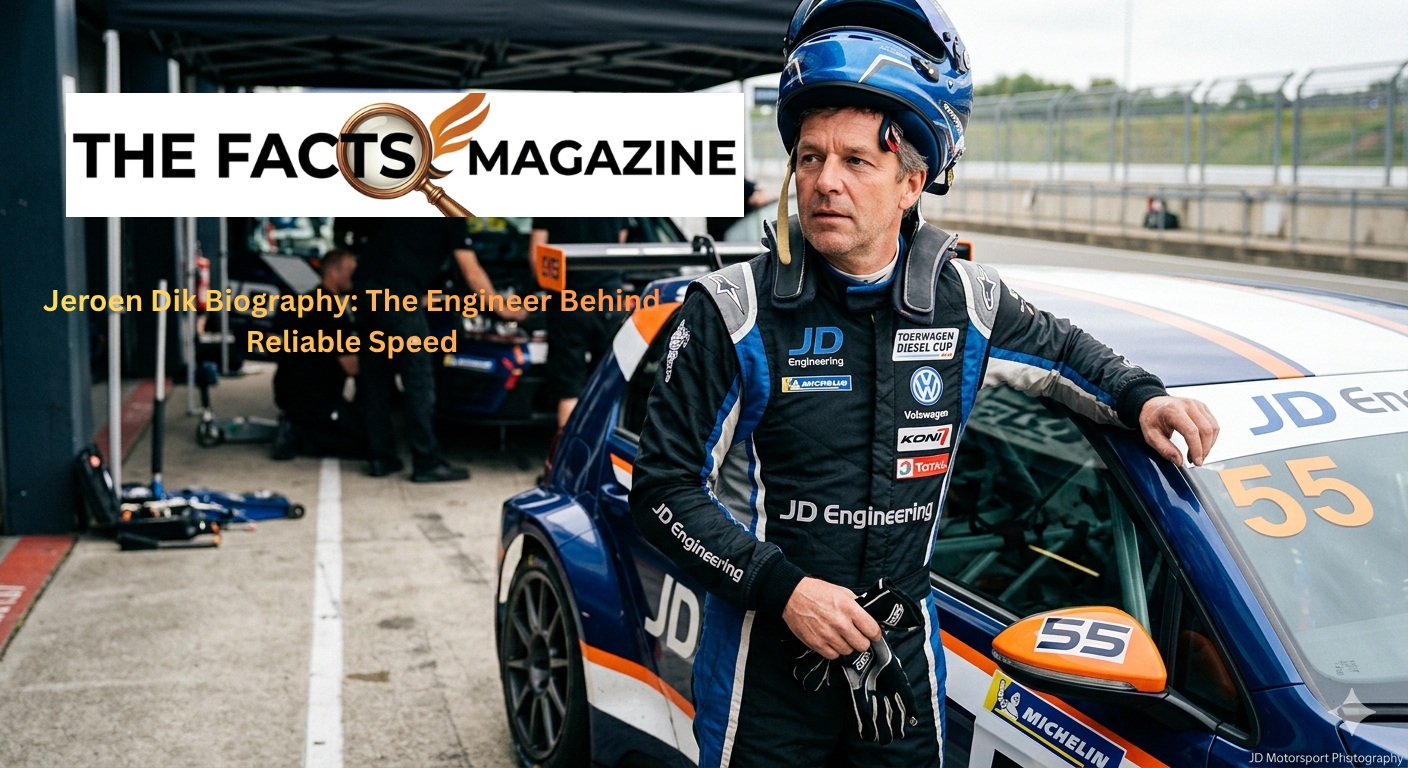
Some people build a name through loud marketing. Jeroen Dik did it the harder way: by making cars faster without making them fragile. That difference matters. In tuning circles, plenty of names come and go, but the ones that last usually belong to people who understand both speed and restraint.
- Quick Bio Table
- Who Is Jeroen Dik?
- The Early Spark: Mechanical Curiosity From the Start
- JD Engineering and the Making of a Reputation
- Why the VAG Community Knows His Name
- The Racing Side of the Story
- The 2011 Toerwagen Diesel Cup Championship
- “Tuning Yoda” and What the Nickname Really Means
- Power You Can Live With
- Education, Skill Development, and Practical Engineering
- Beyond Horsepower: The JD Engineering Style
- Smooth, usable performance
- Respect for mechanical limits
- Testing over guessing
- Long-term customer trust
- Family Life and Personal Side
- Why Jeroen Dik Keeps Getting Attention
- Moving Into Hybrid and EV Tuning
- Public Image: Quiet Authority Over Hype
- Lesser Known Facts About Jeroen Dik
- Net Worth and Income Sources
- Final Thoughts on Jeroen Dik’s Legacy
This Jeroen Dik biography takes a closer look at the Dutch engineer, race driver, and founder of JD Engineering. It covers his early mechanical interest, his rise in performance tuning, his 2011 racing title, and the philosophy that made him stand out in the VAG world. It also explains why enthusiasts still talk about him with a kind of quiet respect.
Quick Bio Table
|
Detail |
Information |
|---|---|
|
Name |
Jeroen Dik |
|
Age |
57 (as of 2026) |
|
Birth Date |
March 13, 1969 |
|
Birth Year |
1969 |
|
Nationality |
Dutch |
|
Profession |
Automotive engineer, performance tuner, race driver, founder of JD Engineering |
|
Famous For |
JD Engineering, VAG tuning expertise, 2011 Toerwagen Diesel Cup title |
|
Marital Status |
Not publicly available |
Who Is Jeroen Dik?
Jeroen Dik is a Dutch automotive engineer and performance tuner best known as the founder of JD Engineering, a respected tuning company based in the Netherlands. He is also known as a former race driver, especially for winning the 2011 Toerwagen Diesel Cup.
Among enthusiasts, though, his reputation goes beyond a title or a company name. He is widely linked with careful ECU calibration, strong real-world performance, and a tuning style that values engine health as much as horsepower. That balance is a big part of why he is often mentioned in conversations about Volkswagen, Audi, SEAT, and Škoda performance.
Interestingly, Jeroen Dik is not the kind of automotive figure who became famous through flashy self-promotion. His profile grew because drivers trusted the results. In a field full of bold claims, that says a lot.
Also Read: Judy Schelin: A Deep Look Into Her Life From Childcare Leader to Public Controversy
The Early Spark: Mechanical Curiosity From the Start
Most engineers have a moment when machines stop being objects and start becoming puzzles. For Jeroen Dik, that curiosity appears to have started early. He is often described as someone drawn to engines, mechanics, and the way systems behave under pressure.
That kind of interest usually leaves a mark. People who think this way rarely settle for “it works.” They want to know why it works, how it can work better, and what happens when one small setting changes everything else. In Jeroen’s case, that mindset later became central to his tuning work.
What stands out is that his path seems rooted less in image and more in hands-on understanding. You see that often with the most trusted builders and calibrators. They are not chasing attention first. They are chasing precision.
JD Engineering and the Making of a Reputation
Jeroen Dik founded JD Engineering in Lochem, Netherlands. Over time, the company built a strong name in European performance tuning, especially within the VAG group world: Volkswagen, Audi, SEAT, and Škoda, along with selected Porsche applications.
JD Engineering became known for a simple but demanding standard: performance should feel strong, smooth, and dependable. That may sound obvious, but in tuning, it is not always the norm. Some setups are built to impress on paper or on a single dyno run. JD Engineering earned trust by aiming for something more useful—power that drivers could live with every day.
That reputation made the company especially attractive to owners who wanted more from their cars without sacrificing drivability. Whether the vehicle was a hot hatch, a turbocharged daily driver, or a track-focused build, the emphasis stayed the same: optimize carefully, test properly, and respect the limits of the machine.
Why the VAG Community Knows His Name
If you spend enough time around modified Volkswagens or Audis, you start noticing that certain tuning names come up again and again. Jeroen Dik is one of them.
His strongest public association is with VAG platforms. That includes everything from practical diesel models to higher-performance gasoline cars. The VAG ecosystem is huge, but it also demands specialized knowledge because engine control, turbo behavior, fueling, and gearbox response can vary a lot across models and generations.
This is where Jeroen Dik’s expertise seems to have landed so well. He built credibility in a community that values proof. Drivers want gains, of course, but they also want stable operation, usable torque, and confidence that the car will not become temperamental after the tune.
In that sense, his work sits in a similar lane to other respected European tuning specialists: technical first, marketing second. And for many enthusiasts, that is the more convincing order.
The Racing Side of the Story
A big reason Jeroen Dik’s name carries extra weight is that he was not only working on cars—he was also competing. That matters. Engineers who race tend to learn differently because the track exposes every weak point.
His most widely recognized competitive achievement came in the Toerwagen Diesel Cup, a Dutch touring car series that gave him a real stage to prove his approach under pressure. Motorsport is brutally honest. If a tuning philosophy sounds good but fails in heat, load, or long sessions, the track finds out fast.
That racing background adds an important layer to the Jeroen Dik biography. It helps explain why his tuning style became associated with reliability and data-driven thinking. Winning is one thing. Winning with a well-prepared diesel race car says something even more specific about discipline, setup, and control.
The 2011 Toerwagen Diesel Cup Championship
In 2011, Jeroen Dik won the Toerwagen Diesel Cup championship, a milestone that remains one of the clearest markers of his motorsport career.
This title was important for more than trophy value. It showed that his engineering ideas could hold up in competition, not just on the road or in workshop theory. The championship helped confirm what many enthusiasts already suspected: his understanding of performance was not based on hype. It was tested.
There is something especially fitting about this success happening in diesel racing. Diesel performance is not always glamorous to outsiders, but people inside the scene understand the challenge. Extracting speed while preserving durability demands patience and technical depth. It is less about drama and more about mastery.
That, in a way, matches Jeroen Dik’s public image rather well.
“Tuning Yoda” and What the Nickname Really Means
Nicknames in car culture can be silly, exaggerated, or oddly perfect. “Tuning Yoda” is one of the better ones.
Jeroen Dik earned this nickname because of his calm, highly technical reputation in the tuning community. The label suggests someone experienced, measured, and maybe a little mysterious—someone who does not need to shout to be taken seriously.
It also reflects a certain teaching quality. In specialist communities, the most respected figures are often the ones who can explain difficult concepts simply and apply them consistently. The nickname hints at wisdom more than fame.
And honestly, that may be why it stuck. Jeroen Dik’s appeal does not come from celebrity in the usual sense. It comes from the idea that if you want a car tuned properly, you look for the person who understands the whole system, not just the peak number.
Power You Can Live With
If one phrase sums up his approach, it is this: “Power You Can Live With.”
That line captures a lot. It is not anti-performance. Far from it. Instead, it argues that the best tuning gives you extra power in a form that still feels natural, usable, and dependable. Not jerky. Not fragile. Not built for one dramatic pull and a long repair bill later.
This philosophy helps explain JD Engineering’s staying power. It speaks to drivers who actually use their cars—people who care about throttle response, smooth torque delivery, sensible thermal management, and long-term reliability.
There is also a larger lesson in it. Good engineering often looks less dramatic than bad engineering. It feels composed. It works day after day. That can seem less exciting on social media, but in the real world, it wins loyalty.
Education, Skill Development, and Practical Engineering
Specific details about Jeroen Dik’s formal education are not publicly available. What is publicly visible, however, is a career built on practical expertise and deep technical skill.
In automotive tuning, formal credentials matter less than results, especially when those results hold up over years. ECU mapping, diagnostics, turbo optimization, engine behavior analysis, and drivability refinement all require a strong applied understanding of engineering principles. Jeroen Dik’s reputation suggests exactly that kind of knowledge base.
This is worth noting because some of the best-known specialists in automotive performance did not become influential through titles alone. They became influential by solving problems repeatedly, improving systems carefully, and building trust car by car.
That kind of development is slower. It is also harder to fake.
Beyond Horsepower: The JD Engineering Style
JD Engineering’s identity has long been tied to a more conservative and precise style of tuning. In this context, “conservative” is not a criticism. It often means avoiding reckless setups and chasing a stronger all-around result.
That style includes a few ideas enthusiasts consistently value:
Smooth, usable performance
A tune should improve the whole driving experience, not just the top-end headline figure.
Respect for mechanical limits
Pushing too far can make a car feel impressive for a short time, but it often compromises reliability.
Testing over guessing
Proper calibration depends on data, diagnostics, and real feedback, not assumption.
Long-term customer trust
A reputation in tuning is built one satisfied owner at a time, and it can be lost quickly if cars fail.
This approach may be one reason his name continues to circulate even as trends change. Car culture moves fast, but trust moves slower and lasts longer.
Family Life and Personal Side
Information about Jeroen Dik’s family, spouse, or children is not publicly available in a detailed, verified form.
That said, his public image suggests a figure who has remained more focused on technical work than personal publicity. For many readers, that may actually add to the intrigue. In automotive circles, some of the most respected names are not highly visible personalities. They are known through their work, not through constant self-exposure.
There is a certain old-school quality in that. The attention stays on the craft.
Why Jeroen Dik Keeps Getting Attention
There are a few reasons search interest around his name remains strong.
First, JD Engineering has lasting recognition in the European tuning world. Second, motorsport history gives his name credibility beyond the workshop. Third, the tuning industry itself keeps changing, and enthusiasts often look back to respected figures when judging who has adapted well and who has not.
People also search for him because he sits at the intersection of several interests: engineering, racing, tuning culture, and VAG performance. That overlap makes his story more than a standard career profile.
A brief observation here: many niche automotive figures become interesting precisely because they are not mainstream celebrities. They feel more earned. Their influence comes from doing the work well for a long time, and that tends to attract serious readers and serious enthusiasts.
Moving Into Hybrid and EV Tuning
One of the more interesting recent developments in the Jeroen Dik story is the connection to hybrid and EV tuning. As the automotive world shifts, performance specialists have to decide whether they will adapt or become historical footnotes.
Jeroen Dik appears to be among the tuners willing to engage with newer technology. That matters because hybrid and electric platforms require a different mindset. Traditional mechanical tuning still matters in some areas, but software control, system integration, efficiency management, and new performance logic play a much larger role.
For someone already known for ECU knowledge and careful calibration, this move feels like a natural extension rather than a forced rebrand. It suggests that his interest was never only about old-school combustion power. It was about understanding performance systems in whatever form they take next.
Also Read: Who is Oliver Tress? All About the Untold Story of the Oliver Bonas Founder
Public Image: Quiet Authority Over Hype
Jeroen Dik’s public image is closer to “trusted specialist” than “automotive celebrity.” He is not widely known through entertainment media, and that has shaped how people see him.
His authority seems to come from consistency. Customers, racers, and enthusiasts tend to respect figures who stay focused on the work. In many ways, his image reflects the best version of technical credibility: low noise, high trust.
That is part of what makes this Jeroen Dik biography interesting. The story is not built around scandal, glamour, or heavy self-branding. It is built around competence. That may sound plain, but in specialist industries, competence is often the rarest thing people are looking for.
Lesser Known Facts About Jeroen Dik
- He is most strongly associated with VAG tuning, especially Volkswagen, Audi, SEAT, and Škoda platforms.
- His 2011 diesel racing title helped validate his tuning ideas under real motorsport stress.
- The nickname “Tuning Yoda” reflects community respect for his calm and technical style, not just a catchy label.
- His tuning philosophy favors real-world drivability over attention-grabbing peak figures.
- He is also linked with the industry’s shift toward hybrid and EV performance development, showing a willingness to evolve.
Net Worth and Income Sources
Jeroen Dik’s exact net worth is not publicly available.
His likely income sources are easier to identify in broad terms. They include his work through JD Engineering, performance tuning services, ECU calibration, automotive consulting, and the brand value connected to a respected name in the tuning industry.
As with many specialist automotive figures, the bigger story is not celebrity wealth. It is long-term professional credibility. In fields like this, reputation is often the most valuable asset.
Final Thoughts on Jeroen Dik’s Legacy
Jeroen Dik’s story stands out because it feels grounded. He is not famous for being everywhere. He is respected for getting things right.
From early mechanical curiosity to founding JD Engineering, from VAG tuning expertise to a 2011 championship, his path shows what happens when engineering discipline meets motorsport experience. Add in the “Power You Can Live With” mindset, and you get a figure who represents a smarter kind of performance culture.
That may be why interest in him continues. He appeals to people who like cars, yes, but also to people who value craft. And in a space where noise often gets more attention than substance, Jeroen Dik remains notable for the opposite reason: he built a name on substance first.
For More information visit The Facts Magazine