Introduction: What People Mean by “Software Bixiros.5a8 Development Process”
If you’ve landed here after typing something like “why is software Bixiros.5a8 development process” into a search bar, you’re probably a little confused. And honestly, that’s fair.
- Introduction: What People Mean by “Software Bixiros.5a8 Development Process”
- Is Bixiros.5a8 a Real Software Product or an Internal Project Name?
- What Does Software Bixiros.5a8 Development Process Mean?
- Why a Structured Software Development Process Matters
- The Core Phases of the Software Development Lifecycle
- 1. Planning and Requirements Analysis
- 2. System Design and Architecture
- 3. Coding and Implementation
- 4. Testing and Quality Assurance
- 5. Deployment, Release, and Maintenance
- How the Setup Workflow Likely Works in a Project Like Bixiros.5a8
- Environment Setup and Runtime Requirements
- Configuration Files, Endpoints, Keys, and Feature Flags
- Build, Dependency Resolution, and Generated Code
- Bootstrap, Data Seeding, and Schema Initialization
- Local Development, Testing, and Linting Workflow
- Promotion Flow Across Dev, Staging, and Production
- Why the Sequence of Development Stages Matters
- What Happens When Teams Skip Planning, Design, or Testing
- Agile vs Waterfall in the Bixiros.5a8 Development Context
- Common Problems Developers Face With Unclear Documentation
- How to Map an Unclear Software Process Step by Step
- Key Benefits of a Good Software Development Process
- Why People Search for Software Bixiros.5a8 Development Process
- Frequently Asked Questions About Software Bixiros.5a8 Development Process
- Conclusion
The phrase looks technical. It sounds like it should point to a real product page or some official documentation. But when you go looking, you don’t find a clean answer. So people start wondering what the software Bixiros.5a8 development process actually is, whether it matters, and how a project like this would move from an idea to a working release.
Here’s the thing. The name might be a codename, a build tag, or an internal project label. What doesn’t change is the process behind it. Every piece of software follows a lifecycle, and understanding that lifecycle is far more useful than chasing a mysterious name. So that’s what we’ll do here — explain the real workflow, the stages, and why the sequence matters.
|
Quick Answer |
Details |
|---|---|
|
Is Bixiros.5a8 documented? |
No verified public documentation is available |
|
Likely meaning |
Internal tool, build artifact, or project identifier |
|
Core SDLC phases |
Planning, Design, Coding, Testing, Deployment/Maintenance |
|
Why the process matters |
Reduces bugs, lowers cost, improves quality and security |
|
Common methodologies |
Agile, Waterfall, Scrum, Kanban |
|
Biggest risk |
Skipping stages, which creates technical debt and rework |
Is Bixiros.5a8 a Real Software Product or an Internal Project Name?
Let’s clear this up first. There is no verified public documentation, vendor website, GitHub repository, or package registry entry (npm, PyPI, NuGet, Maven Central) that officially defines Bixiros.5a8 as a released product. That information is simply not publicly available.
What’s interesting is how the name is structured. The “.5a8” part looks a lot like a semantic version component or a short build hash. That pattern usually shows up in things like a build artifact, a pipeline tag, a firmware label, or a private module inside a company’s internal toolchain.
So the most honest read is this: Bixiros.5a8 is likely a proprietary or internal project identifier — the kind of thing you’d see inside a private repo, not on a public product page. That doesn’t make the software development process behind it any less real. It just means we explain it using standard software engineering principles instead of guessing at fake facts.
What Does Software Bixiros.5a8 Development Process Mean?
Strip away the odd name and the software Bixiros.5a8 development process simply means the software development lifecycle (SDLC) applied to one specific project.
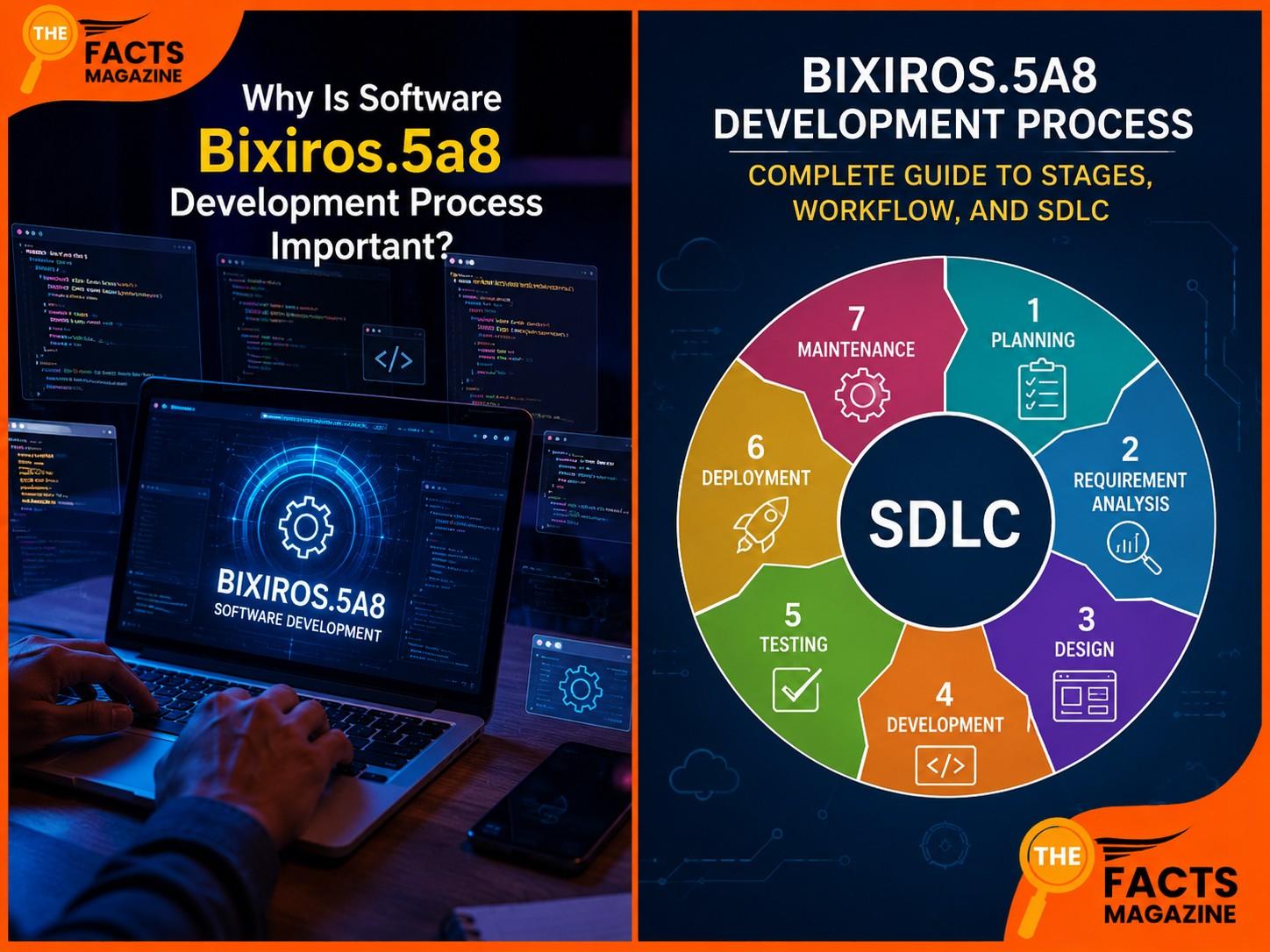
In plain terms, it’s the roadmap a development team follows to take a rough idea and turn it into working, deployable software. That roadmap covers planning, requirements analysis, system design, coding, testing, deployment, and maintenance.
For an internal project like this one, there’s usually a second layer too — the practical setup workflow. Things like environment setup, configuration files, dependency resolution, and how the code moves from a developer’s laptop to production. That’s the part people struggle with most, especially when documentation gaps leave hidden dependencies undocumented.
Why a Structured Software Development Process Matters
To be honest, a lot of teams learn this lesson the hard way. A structured process isn’t bureaucracy — it’s insurance.
When you follow clear workflow stages, you catch issues early, keep the team aligned, and make the whole thing reproducible. Without it, you get budget overruns, missed deadlines, and bugs that slip into production.
There’s a well-known rule of thumb in software engineering: a bug caught during planning might cost almost nothing to fix, but the same bug found in production can cost 10 to 100 times more. That single idea explains why process discipline saves money, protects reliability, and builds user trust.
The Core Phases of the Software Development Lifecycle
Most teams break the SDLC into five core phases. Whether they call the project Bixiros.5a8 or anything else, these stages stay roughly the same.
1. Planning and Requirements Analysis
Everything starts here. The team gathers business requirements, functional requirements, and non-functional requirements from stakeholders and end users. Product managers and business analysts define the scope, sort out what the software must do, and set priorities.
Get this wrong and you build the wrong thing beautifully. That’s why requirement gathering and scope definition sit at the very front of the software Bixiros.5a8 development process.
2. System Design and Architecture
Next comes the technical blueprint. Engineers map out the software architecture, choosing between high-level design and low-level design details. They plan the database structure, define API contracts, and sometimes sketch UX wireframes.
Good design thinks ahead about scalability. A system built for 1,000 users behaves very differently from one expected to handle 100,000, so those decisions get made now, not later.
3. Coding and Implementation
This is where source code finally gets written. Developers and software engineers turn the design into real implementation, aiming for clean code quality, modularity, and clear separation of concerns.
Version control with Git keeps everything organized. A solid branch strategy, pull requests, and a code review process help the development team avoid stepping on each other’s work.
4. Testing and Quality Assurance
Now QA engineers earn their keep. Testing runs across several layers: unit testing, integration testing, system testing, and user acceptance testing. Teams also run regression testing, performance testing, security testing, and compatibility testing.
Automated testing catches problems fast, and security testing guards against things like SQL injection, cross-site scripting, broken authentication, and insecure dependencies. Skip this stage and those vulnerabilities go live.
5. Deployment, Release, and Maintenance
Finally, the software ships. Deployment pushes the release into the production environment, often through a CI/CD pipeline. But the job isn’t over.
Maintenance keeps things healthy — updates, patches, monitoring, observability, and logging. Over years or even decades, this phase handles bug fixing, performance optimization, and security improvements. Eventually some systems reach retirement or decommissioning.
Also Read: When Is UStudioBytes Released? Date, Beta & Features
How the Setup Workflow Likely Works in a Project Like Bixiros.5a8
Here’s where an internal project gets tricky. The setup workflow is often the least documented part, yet it’s exactly what a new developer needs on day one. Let’s decode a realistic flow.
Environment Setup and Runtime Requirements
First, you need the right runtime and matching package versions. A common source of pain is environment mismatch — the code works on one machine and breaks on another. Aligning repository dependencies and the local development setup fixes most of that.
Configuration Files, Endpoints, Keys, and Feature Flags
Next comes the config stage. This usually means environment files, service endpoints, API keys, and feature flags. One wrong value here and nothing connects properly, which is why configuration errors trip up so many people early on.
Build, Dependency Resolution, and Generated Code
Then the project needs a clean build. Dependency resolution pulls in what’s required, and some projects rely on generated code that must be created before anything compiles. Miss this and you’ll hit errors that feel random but really aren’t.
Bootstrap, Data Seeding, and Schema Initialization
Many systems need a bootstrap step. That covers schema creation, running migrations, seeding local data, and setting up caches. This is often a one-time step, not something you repeat daily — and knowing the difference saves a lot of frustration.
Local Development, Testing, and Linting Workflow
Once the local app stack is running (often in containers), the everyday routine kicks in: write code, run tests, run linting, repeat. This daily loop is where most of the actual work happens.
Promotion Flow Across Dev, Staging, and Production
Finally, the promotion flow. Code moves through the development environment, then the staging environment, and only after validation into production. This gated path is what keeps unstable releases away from real users.
Why the Sequence of Development Stages Matters
Order is not optional. You can’t test something you haven’t built, and you can’t build something you haven’t designed. Each phase has preconditions — the state transitions from a clean repo state, to initialized, configured, generated, running, and finally a deployable state.
Think of it as a state model. Skip a step and you break the chain, which usually means broken setup or deployment confusion down the line.
What Happens When Teams Skip Planning, Design, or Testing
Cutting corners always feels faster in the moment. It rarely is.
Skip planning and you build features nobody asked for. Skip design and you invite endless rework. Skip testing and bugs — plus security holes — reach production. The result is a familiar mess: technical debt piling up, poor user experience, unstable releases, and painful onboarding for the next engineer who inherits it all.
Also Read: Dianaandr3a: Meaning, Online Presence, Digital Identity, and Recent Updates
Agile vs Waterfall in the Bixiros.5a8 Development Context
Two main mindsets shape how teams run the software Bixiros.5a8 development process.
Waterfall is sequential — you finish one phase completely before starting the next. It’s predictable and works well when requirements are locked.
Agile is iterative. Teams work in short cycles, often 2-week sprints, using Scrum or Kanban. There’s a product backlog, sprint planning, daily standups, and retrospectives. Agile handles changing requirements far better, which is why many modern teams lean on it alongside DevOps and continuous delivery. Plenty of teams use a hybrid model, blending both.
Common Problems Developers Face With Unclear Documentation
Unclear documentation is the quiet killer of productivity. When a README is thin or outdated, new team members hit onboarding friction immediately.
The usual culprits? Hidden prerequisites, undocumented setup steps, missing secrets, and mysterious generated artifacts. Someone joins, follows the docs, and the app still won’t start — because the real workflow lived in someone’s head, not on the page.
How to Map an Unclear Software Process Step by Step
When docs fail, you reverse-engineer the truth. Here’s a practical approach that works on almost any project.
- Inspect the entrypoint. Find where the app actually starts.
- Read the package scripts, makefile, or task runner. These reveal the real commands.
- Check the CI config. The CI/CD pipeline shows exactly how the team builds and deploys, no guessing needed.
- Look at bootstrap scripts and docker-compose. These expose provisioning and runtime orchestration.
- Separate one-time steps from daily steps. Setup versus routine.
- Map state transitions, not just commands. Understand what state the project needs to reach at each point.
This method turns a confusing repo into a clear, reproducible workflow.
Key Benefits of a Good Software Development Process
A disciplined process pays off in ways you feel across the whole project:
- Fewer bugs and stronger stability
- Lower cost of change and faster time to market
- Better collaboration, accountability, and traceability
- Easier onboarding thanks to clear documentation
- Stronger scalability, reliability, and maintainability
- Improved security and better user experience
- Continuous improvement through steady feedback loops
Why People Search for Software Bixiros.5a8 Development Process
So why does this specific query keep popping up? A few honest reasons.
Some people ran into the name inside a private repo or a build log and got curious. Others are students or new developers trying to understand SDLC using a real-sounding example. And some just want to know if Bixiros.5a8 is a real product or a search-generated phrase.
What stands out is that the curiosity is genuinely useful. Digging into the software Bixiros.5a8 development process teaches you the same fundamentals that apply to any software project — which is far more valuable than the name itself.
Also Read: Zimslapt2154: What It Is, Why It’s Trending, and How It Fits the Digital World
Frequently Asked Questions About Software Bixiros.5a8 Development Process
What is Software Bixiros.5a8 development process?
It’s the software development lifecycle applied to a project labeled Bixiros.5a8 — covering planning, design, coding, testing, deployment, and maintenance.
Why is Software Bixiros.5a8 development process important?
Because a structured process reduces bugs, lowers costs, improves security and reliability, and makes development reproducible and easier to maintain.
Is Bixiros.5a8 a real software product?
There is no verified public documentation confirming it as an official product. It’s most likely an internal tool, build artifact, or project identifier.
What are the main stages of the software development process?
Planning and requirements analysis, system design, coding, testing and QA, then deployment and maintenance.
How does a project like Bixiros.5a8 move from setup to deployment?
It goes through environment setup, configuration, build and dependency resolution, bootstrap and schema init, local testing, then promotion across dev, staging, and production.
What happens if the testing phase is skipped?
Bugs and security vulnerabilities reach production, quality drops, and fixing issues later costs far more than catching them early.
How do Agile and Waterfall differ?
Waterfall is sequential and finishes each phase before the next; Agile is iterative, using short sprints and continuous feedback.
Why do developers struggle with unclear documentation?
Because hidden dependencies, undocumented setup steps, and missing secrets aren’t written down, causing onboarding friction and broken setups.
How can teams understand an undocumented project workflow?
By inspecting the entrypoint, package scripts, CI config, and bootstrap scripts, then mapping state transitions and separating one-time steps from daily ones.
What are the benefits of a structured software process?
Better quality, lower cost, clearer accountability, easier onboarding, and stronger scalability, reliability, and security.
Conclusion
At the end of the day, the mystery around the name matters far less than the process behind it. There’s no verified public documentation for Bixiros.5a8, and that’s okay to admit.
What genuinely helps is understanding the software Bixiros.5a8 development process as a standard SDLC — plan, design, build, test, deploy, maintain — layered with a practical setup workflow you can decode yourself. Get those fundamentals right, and you can walk into almost any software project, mysterious name or not, and figure out exactly how it works.
For More information visit The Facts Magazine